Use the same account, currency and cutoff date
Gather the complete bank statement, your record for that account and the previous reconciliation. Compare the same closing date and currency. Keep a different bank account or physical cash out of this comparison.
Match each entry by amount and reference. Processing dates can differ, so retain the evidence linking a collection, its deposit and the statement entry. Review items still outstanding from the previous month before adding new ones.
Identify which side needs attention
A deposit in transit is already in your records but not yet on the statement. An outstanding payment has also been recorded, but the bank has not deducted it yet. Follow these items until the bank reflects them; do not record them again.
A fee already charged by the bank but missing from your records needs a supported entry in the church’s books. The same applies to an identified credit, such as interest or a direct receipt that has not been recorded. Check its purpose and reference before classifying it.
A worked example: both adjusted balances are 1,100
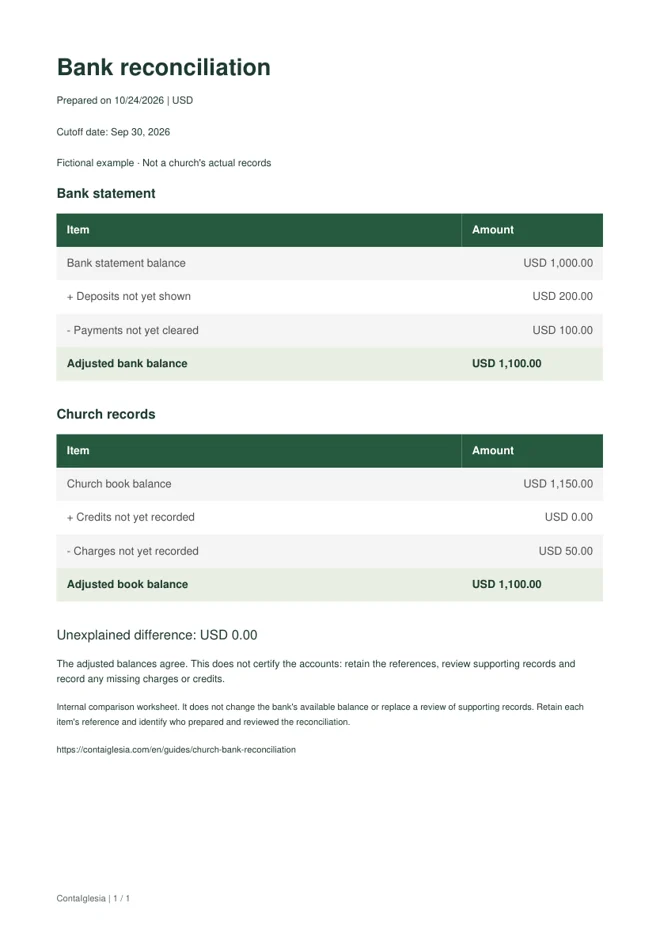
These fictional amounts use one currency. The statement closes at 1,000.00 and the church’s record at 1,150.00. A 200.00 deposit and a 100.00 payment are still outstanding; a 50.00 bank fee has not been entered in the books.
Scroll the table to see every column.
| Bank statement | Amount | Church records | Amount |
|---|---|---|---|
| Statement balance | 1,000.00 | Book balance | 1,150.00 |
| Add outstanding deposit | 200.00 | Unrecorded credits | 0.00 |
| Less outstanding payment | 100.00 | Less fee to record | 50.00 |
| Adjusted bank balance | 1,100.00 | Adjusted book balance | 1,100.00 |
The 50.00 fee needs to be recorded once with supporting evidence. The deposit and payment already in the books need follow-up, not duplicate entries.
Keep the explanation with the comparison
Retain the statement, the list of reconciling items and their references. Identify who prepared and reviewed the reconciliation. Equal adjusted balances do not prove every entry is correct or make the adjusted figure the bank’s available balance.
If a difference remains, check the source entries and unresolved items. Investigate old payments or deposits that never clear. Document a correction to an identified error; avoid an unexplained balancing entry. The worksheet covers the common items shown here, not every possible bank or bookkeeping error.
Worksheet · No account needed
Compare both sides of the reconciliation.
Use one account, currency and cutoff date. Include only items you can identify; leave optional fields blank when they do not apply.
The calculation stays in this browser. Your amounts are not sent and no accounting records are changed. Save the PDF before leaving; this page keeps no history.
Method references
For the relationship between the statement, accounting records and outstanding items:
Before you finish
Does the worksheet connect to my bank?
No. It compares the amounts you enter in this browser. It does not access bank credentials, import a statement or change accounting records.
Does depositing an offering create new income?
Not when that offering was already recorded in cash. Relate the movement from cash to bank to the original collection so the same gift is not counted twice.
Do matching balances certify the accounts?
No. Check each item and its supporting record, and retain who prepared and reviewed the comparison. The result is not an audit opinion or a tax filing.