Agree what confirms that the contribution arrived
Decide what the treasury team checks before confirming receipt: the envelope received with the count, the deposit reference or the incoming transaction found in the bank account. A photo or a message from a member can help locate the record, but it is not confirmation that the church has the money.
Use a shared reference such as a count-sheet number, service date, envelope code or bank transfer reference. Keep the date of receipt consistent so the individual history, collection and accounting period can be checked together.
In this example, a declaration for USD 40 remains pending because receipt has not been confirmed. It stays outside the received total. A promise to contribute toward a project should also remain separate from money already received.
Keep one record for each identified person
A name and the internal identifier used by your church may be sufficient to find the correct history. The identifier helps distinguish people who share a name. Check an existing profile before creating another because a name was spelled differently.
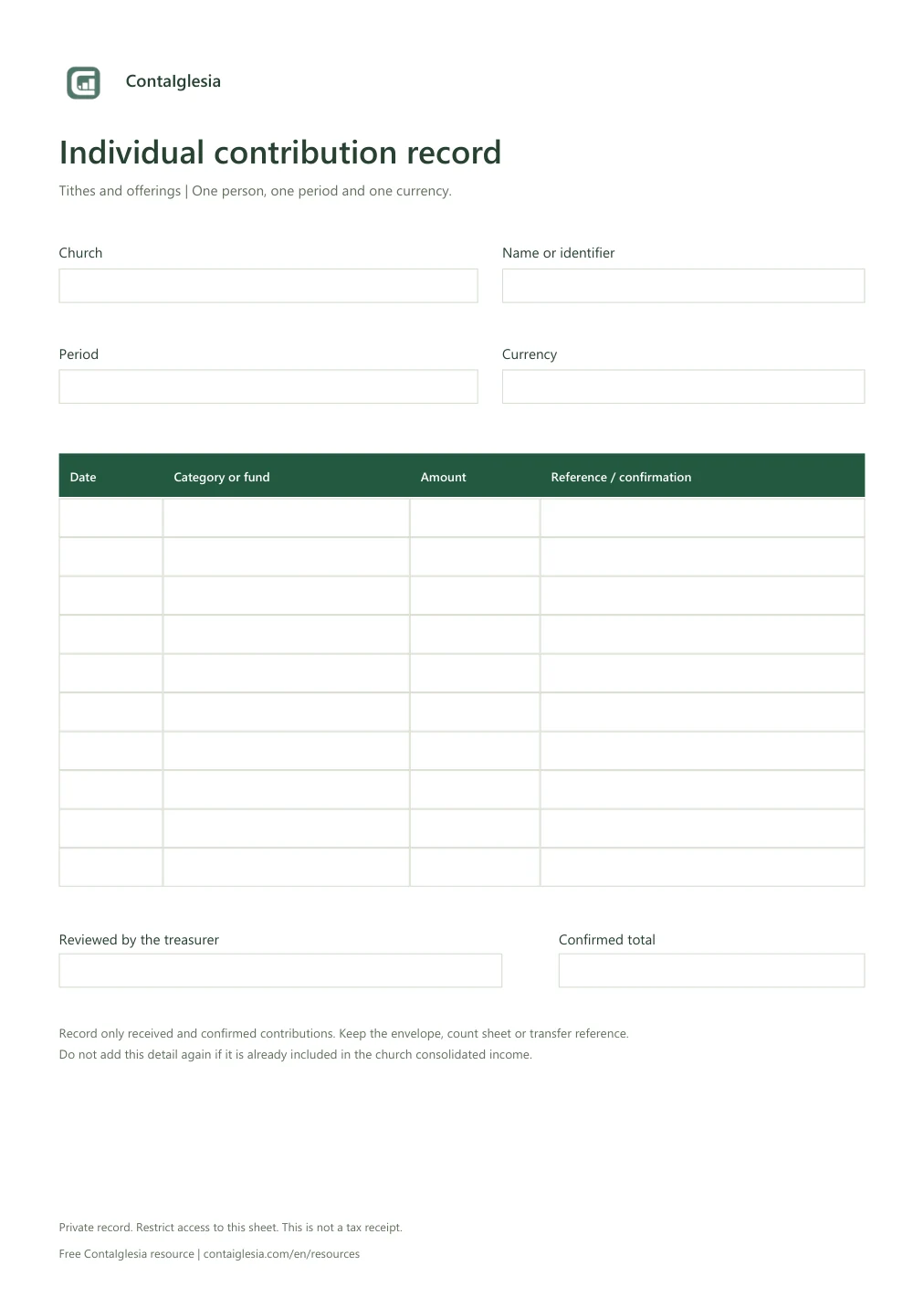
Record the receipt date, amount, currency, purpose and reference. Use consistent purposes such as tithes, general offerings or missions. Do not combine amounts in different currencies into one total without a separately defined conversion procedure.
Members do not all need a digital account. The treasury team can keep individual records from physical envelopes or cards. The account is useful when someone wants to submit details or consult their own confirmed history.
- Keep the information needed to identify the contribution.
- Do not request a member’s salary to record a received gift.
- Leave anonymous offerings anonymous instead of inventing a donor.
Reconcile individual details with the collection total
Count the collection first and retain its reference. In this example, envelope A contains USD 100, envelope B contains USD 50, and anonymous offerings total USD 80. The confirmed individual detail is USD 150; all money received totals USD 230.
If the accounting system records USD 230 as one consolidated income entry, the individual details explain part of that entry. They do not add another USD 150 of income. If a system instead records each received gift as income, its batch summary must summarize those entries rather than become an additional entry.
The pending declaration of USD 40 belongs in the review list. It is not used to make the count or the bank balance appear to match. Keep one consistent recording method throughout the period.
Scroll to see both the confirmed and pending columns.
| Detail | Confirmed received | Pending review |
|---|---|---|
| Identified envelope A | $100.00 | $0.00 |
| Identified envelope B | $50.00 | $0.00 |
| Anonymous offerings | $80.00 | $0.00 |
| Declared contribution C | $0.00 | $40.00 |
| Separate totals | $230.00 | $40.00 |
The received total is USD 230, not USD 270 or USD 380. The pending declaration and the individual breakdown do not add to the confirmed collection.
Let members submit details; confirm them in treasury
A member can provide the date, amount, purpose and reference. The team then checks the actual receipt, confirms the details or requests clarification. A correction should remain understandable to the person checking their record.
ContaIglesia lets the church enable personal member access through its link or QR code. A request must be reviewed and linked to the correct person. The member can submit contribution details and consult their own confirmed history without entering the church’s accounting workspace.
Confirm identity before linking an account to an existing history. A matching display name alone is not enough. The public link or QR is an entry point to request access; it is not a public list of the church’s donors and amounts.
- Submitting a contribution form does not charge or transfer money.
- A person’s history should be available through their own access.
- Paper envelopes and cards can continue alongside digital access.
Resolve discrepancies without losing the explanation
At period-end, compare the individual records with count sheets, deposits and income entries. Look for an envelope with no person assigned, a bank gift still under review, or the same contribution submitted on paper and online.
When a member’s declared details differ from what the team confirms, keep the reference and clarify the difference privately. Correct the appropriate record rather than silently changing the collection total to make the figures agree.
Depositing cash that has already been recorded moves the church’s money between its own accounts. It does not create another gift. After any correction, check both the period summary and the individual history affected by it.
Share a private summary, with pending items distinguished
A useful personal summary shows the period, currency, receipt dates, purposes and confirmed amounts. Keep unresolved declarations outside the confirmed total, with enough information for the person and the treasury team to follow up.
A congregation-wide report can show totals by purpose without displaying every contributor’s name. Avoid sending the complete donor file to a group so everyone can find their own row. Give each person their own summary.
The downloadable contribution card is an internal record. It is not a tax-compliant donation acknowledgement or a substitute for formal documents required in a particular jurisdiction. Keep those requirements separate from this working example.
Try the full process with your team.
Start with a count, an identified contribution and its supporting reference. Check the confirmed history and the accounting total. The web trial lasts 14 days without a card.
Common questions
Does every member need an account?
No. The treasury team can record individual contributions received through envelopes or physical cards. Personal access is useful when a member wants to submit details or check their own digital history.
Can the church keep one income entry per service?
Yes, provided the individual detail is kept as a breakdown of that same income. The collection count, individual details and accounting entry must reconcile without adding the amount twice.
Does a contribution form collect the payment?
No. In this member-access process, a submitted amount or photo is a declaration to review. The treasury team confirms what actually arrived. The form does not charge a card or transfer money.
Does this calculate what a member should tithe?
No. It records contributions received and confirmed. It does not calculate an obligation from personal income or evaluate a member’s spiritual situation.